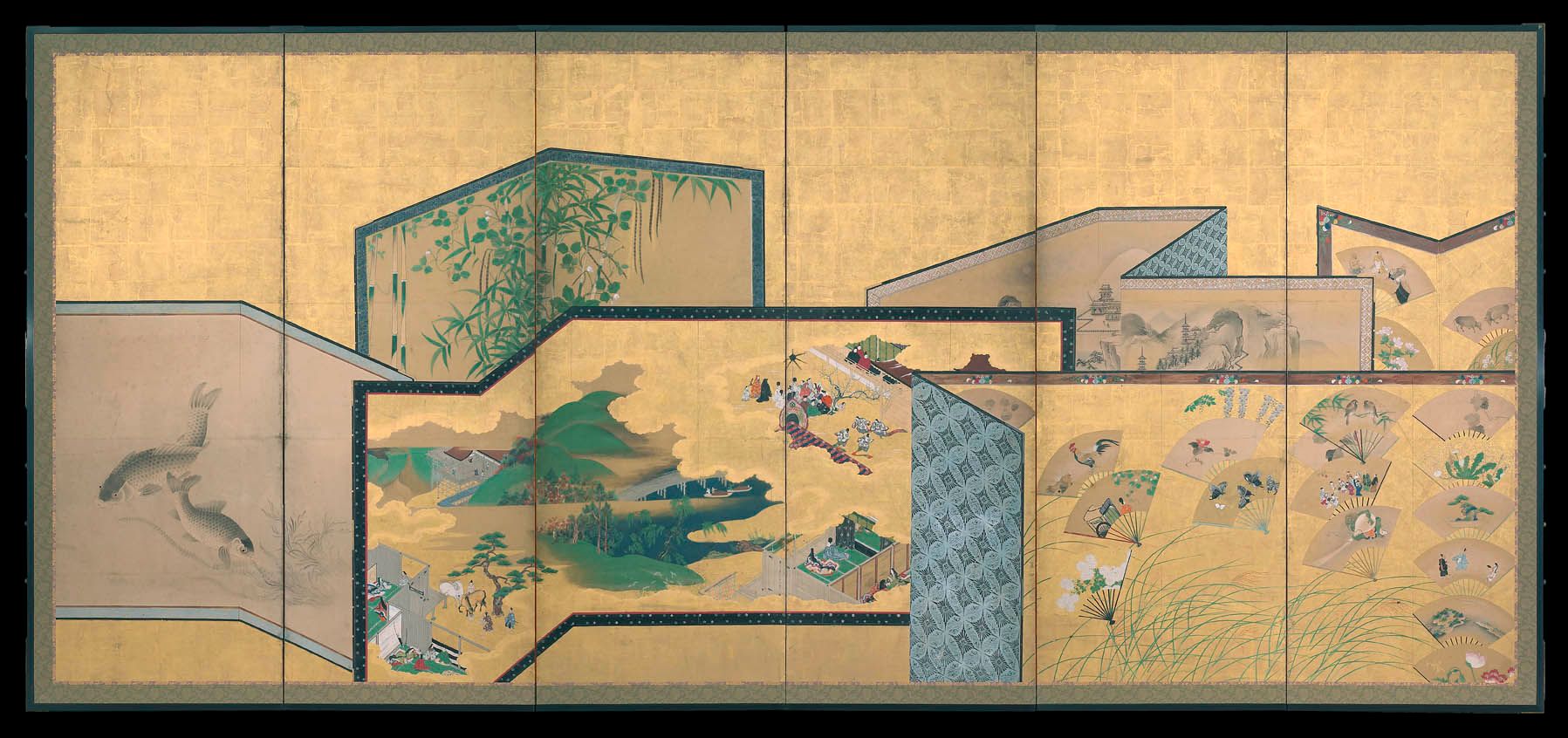
A pair of six-fold paper with sweetfish depicting summer, the revers side with pumpkins and a praying mantis depicting autumn
A pair of six-fold paper makura-byobu (pillow screens) painted in ink and colour with a school of ayu sweetfish; the reverse side of the screen depicting vines of pumpkins and a praying mantis, by Nakajima Kaho (1866-1939).
The front side of the right-hand screen dated Taisho jinjutsu chuka (1922 mid-summer), signed Kaho with a seal Kaho no in (seal of Kaho).
The reverse side of the left-hand screen signed Kaho with a seal Kaho no in (seal of Kaho).
Japan, Taisho period, 1922.
Nakajima Kaho is a painter of the Maruyama School. Born in Kyoto, he practiced painting under Mori Kansai (1814-1894) and calligraphy under Tomioka Tessai (1837-1924). Kaho was inspired by the painting style of the renowned artist Maruyama Okyo (1733-1795) who established a new, sophisticated painting mode, combining modern artistic sense of realistic painting and traditional, decorative aesthetic. Kaho produced many screen paintings depicting landscapes, birds and flowers. His works were exhibited on a number of occasions including the Chicago World’s Fair (1893) and the National Industrial Exhibitions in Japan.
The makura-byobu (lit. ‘pillow screens’) are low-height screens, originally meant to be placed at the bedside, or next to pillows, to prevent drafts.
Ayu sweetfish is a highly prized delicacy of summer. It has appeared in many literary works and poems in the history of Japanese literature, including the classical ones such as Kojiki (Records of Ancient Matters, compiled in 712) and many poems included in Manyoshu (Collection of Myriad Leaves, compiled in the late 7th to the early 8th centuries). Ayu is the kigo (lit. ‘season word’) generally associated with summer in Japanese literature but is also used to represent other seasons: young ayu for spring, ayu moving down the stream for autumn, and juvenile fish for winter, showing its relevance to four seasons.